
Quickstart#
This document tries to follow the tskit quickstart.
A tree sequence represents the ancestral relationships between a set of DNA sequences. It provides an efficient way to store genetic variation data. For a more comprehensive description of tree sequence see What is a tree sequence?
Any tree sequences generated or not with msprime can be loaded and a summary table printed
import tskit
import string
import numpy as np

from tskitetude import get_project_dir
Collect the `` from GitHub:
wget https://github.com/tskit-dev/tskit/raw/main/docs/data/basic_tree_seq.trees -O data/basic_tree_seq.trees
# load a sample tree sequence
ts = tskit.load(get_project_dir() / "data/basic_tree_seq.trees")  # Or generate using e.g. msprime.sim_ancestry()
ts  # In a Jupyter notebook this displays a summary table. Otherwise use print(ts)
 Tree Sequence
|
|
|---|---|
| Trees | 4 |
| Sequence Length | 10 000 |
| Time Units | generations |
| Sample Nodes | 6 |
| Total Size | 3.5 KiB |
| Metadata | No Metadata |
| Table | Rows | Size | Has Metadata |
|---|---|---|---|
| Edges | 20 | 648 Bytes | |
| Individuals | 3 | 108 Bytes | |
| Migrations | 0 | 8 Bytes | |
| Mutations | 5 | 201 Bytes | |
| Nodes | 14 | 400 Bytes | |
| Populations | 1 | 224 Bytes | ✅ |
| Provenances | 2 | 1.7 KiB | |
| Sites | 5 | 141 Bytes |
| Provenance Timestamp | Software Name | Version | Command | Full record |
|---|---|---|---|---|
| 14 July, 2022 at 09:51:11 PM | msprime | 1.2.0 | sim_mutations |
Detailsdictschema_version: 1.0.0
software:
dictname: msprimeversion: 1.2.0
parameters:
dictcommand: sim_mutations
tree_sequence:
dict__constant__: __current_ts__rate: 2e-07 model: None start_time: None end_time: None discrete_genome: None keep: None random_seed: 123
environment:
dict
os:
dictsystem: Darwinnode: Yans-New-Air release: 20.6.0 version: Darwin Kernel Version 20.6.0: Tue Feb 22 21:10:41 PST 2022; root:xnu- 7195.141.26~1/RELEASE_X86_64 machine: x86_64
python:
dictimplementation: CPythonversion: 3.9.10
libraries:
dict
kastore:
dictversion: 2.1.1
tskit:
dictversion: 0.5.1
gsl:
dictversion: 2.7 |
| 14 July, 2022 at 09:51:11 PM | msprime | 1.2.0 | sim_ancestry |
Detailsdictschema_version: 1.0.0
software:
dictname: msprimeversion: 1.2.0
parameters:
dictcommand: sim_ancestrysamples: 3 demography: None sequence_length: 10000.0 discrete_genome: None recombination_rate: 1e-07 gene_conversion_rate: None gene_conversion_tract_length: None population_size: 1000 ploidy: None model: dtwf initial_state: None start_time: None end_time: None record_migrations: None record_full_arg: None num_labels: None random_seed: 665 replicate_index: 0
environment:
dict
os:
dictsystem: Darwinnode: Yans-New-Air release: 20.6.0 version: Darwin Kernel Version 20.6.0: Tue Feb 22 21:10:41 PST 2022; root:xnu- 7195.141.26~1/RELEASE_X86_64 machine: x86_64
python:
dictimplementation: CPythonversion: 3.9.10
libraries:
dict
kastore:
dictversion: 2.1.1
tskit:
dictversion: 0.5.1
gsl:
dictversion: 2.7 |
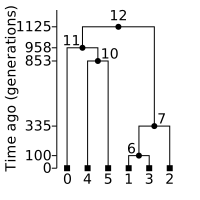
Get and print first tree in sequence:
first_tree = ts.first()
print("Total branch length in first tree is", first_tree.total_branch_length, ts.time_units)
print("The first of", ts.num_trees, "trees is plotted below")
first_tree.draw_svg(y_axis=True)  # plot the tree: only useful for small trees
Total branch length in first tree is 4496.0 generations
The first of 4 trees is plotted below
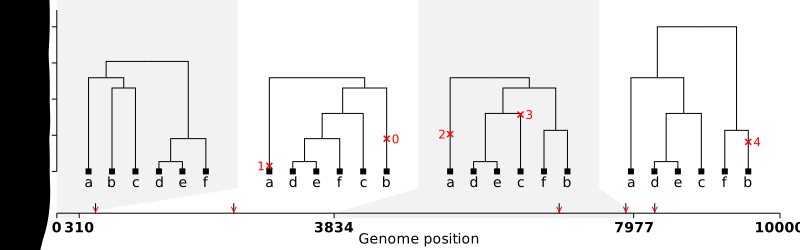
Printing trees with mutation sites:
# Extra code to label and order the tips alphabetically rather than numerically
labels = {i: string.ascii_lowercase[i] for i in range(ts.num_nodes)}
genome_order = [n for n in ts.first().nodes(order="minlex_postorder") if ts.node(n).is_sample()]
labels.update({n: labels[i] for i, n in enumerate(genome_order)})
style1 = (
    ".node:not(.sample) > .sym, .node:not(.sample) > .lab {visibility: hidden;}"
    ".mut {font-size: 12px} .y-axis .tick .lab {font-size: 85%}")
sz = (800, 250)  # size of the plot, slightly larger than the default

# ticks = [0, 5000, 10000, 15000, 20000]
# get max generations time:
max_time = ts.node(ts.get_num_nodes() - 1).time
ticks = np.linspace(0, max_time, 5)
ts.draw_svg(
    size=sz, node_labels=labels, style=style1, y_label="Time ago",
    y_axis=True, y_ticks=ticks)
Extract genetic data#
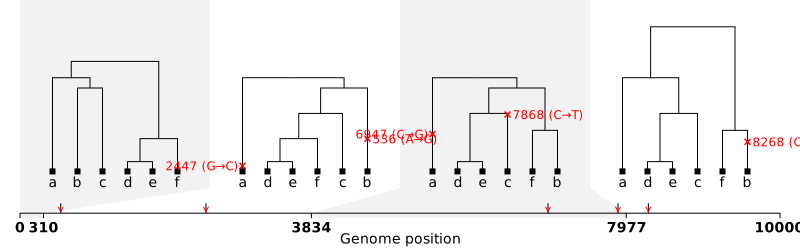
A tree sequence provides an extremely compact way to store genetic variation data. The trees allow this data to be decoded at each site:
for variant in ts.variants():
    print(
        "Variable site", variant.site.id,
        "at genome position", variant.site.position,
        ":", [variant.alleles[g] for g in variant.genotypes],
    )
Variable site 0 at genome position 536.0 : ['A', 'A', 'A', 'A', 'G', 'A']
Variable site 1 at genome position 2447.0 : ['C', 'G', 'G', 'G', 'G', 'G']
Variable site 2 at genome position 6947.0 : ['G', 'C', 'C', 'C', 'C', 'C']
Variable site 3 at genome position 7868.0 : ['C', 'C', 'C', 'C', 'C', 'T']
Variable site 4 at genome position 8268.0 : ['C', 'C', 'C', 'C', 'T', 'C']
Here is how I can display mutations in trees (adapted from An efficient encoding of DNA data):
mut_labels = {}  # An array of labels for the mutations, listing position & allele change
l = "{:g} ({}→{})"
for mut in ts.mutations():  # This entire loop is just to make pretty labels
    site = ts.site(mut.site)
    older_mut = mut.parent >= 0  # is there an older mutation at the same position?
    prev = ts.mutation(mut.parent).derived_state if older_mut else site.ancestral_state
    mut_labels[mut.id] = l.format(site.position, prev, mut.derived_state)

# Extra code to label and order the tips alphabetically rather than numerically
labels = {i: string.ascii_lowercase[i] for i in range(ts.num_nodes)}
genome_order = [n for n in ts.first().nodes(order="minlex_postorder") if ts.node(n).is_sample()]
labels.update({n: labels[i] for i, n in enumerate(genome_order)})
style1 = (
    ".node:not(.sample) > .sym, .node:not(.sample) > .lab {visibility: hidden;}"
    ".mut {font-size: 12px} .y-axis .tick .lab {font-size: 85%}")
sz = (800, 250)  # size of the plot, slightly larger than the default

ts.draw_svg(
    size=sz, style=style1, node_labels=labels, mutation_labels=mut_labels)
Analysis#
Tree sequences enable efficient analysis of genetic variation using a comprehensive range of built-in Statistics:
genetic_diversity = ts.diversity()
print("Av. genetic diversity across the genome is", genetic_diversity)

branch_diversity = ts.diversity(mode="branch")
print("Av. genealogical dist. between pairs of tips is", branch_diversity,  ts.time_units)
Av. genetic diversity across the genome is 0.00016666666666666666
Av. genealogical dist. between pairs of tips is 1645.8752266666668 generations
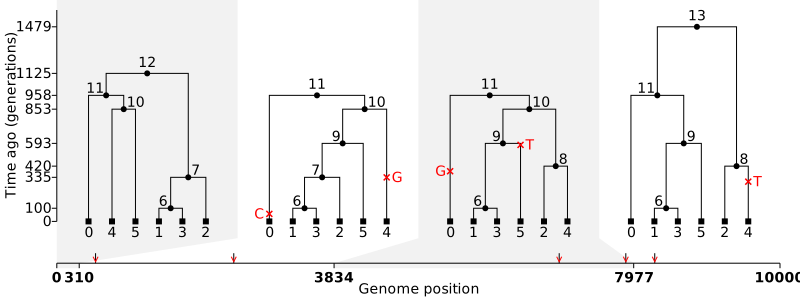
Plotting the whole tree sequence#
This can give you a visual feel for small genealogies:
ts.draw_svg(
    size=(800, 300),
    y_axis=True,
    mutation_labels={m.id: m.derived_state for m in ts.mutations()},
)
Underlying data structures#
The data that defines a tree sequence is stored in a set of tables. These tables can be viewed, and copies of the tables can be edited to create a new tree sequence.
# The sites table is one of several tables that underlie a tree sequence
ts.tables.sites
| id | position | ancestral_state | metadata |
|---|---|---|---|
| 0 | 536 | A | |
| 1 | 2,447 | G | |
| 2 | 6,947 | C | |
| 3 | 7,868 | C | |
| 4 | 8,268 | C |